
Hair Loss & Thinning
**Korean medicine for hair that is falling, thinning, or greying early**
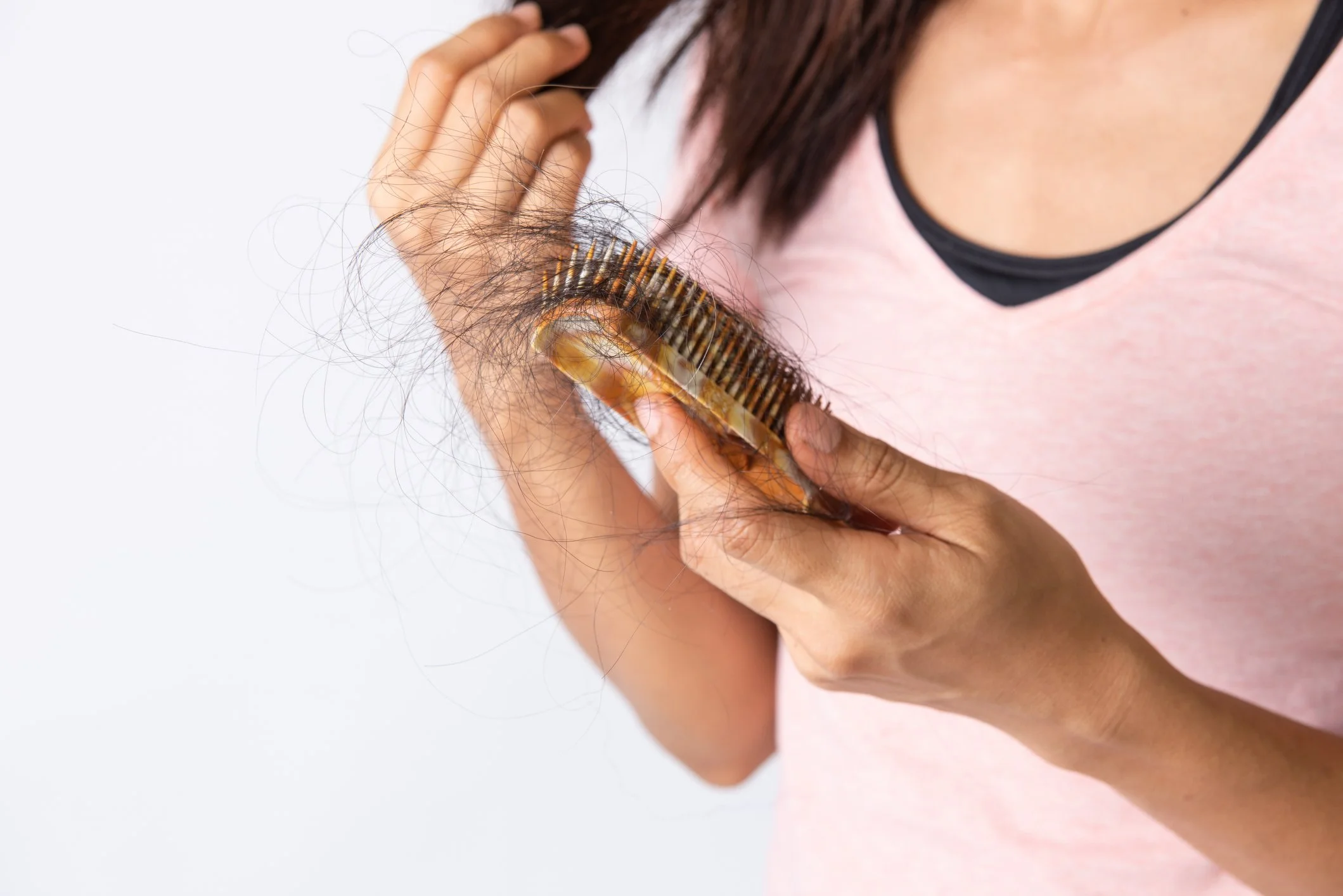
Losing hair is rarely just about hair. It usually arrives alongside something else — a period of relentless stress, a long illness, a pregnancy, a stretch of poor sleep, a diet that went sideways — and it tends to show up a few months after the thing that caused it, which is why the connection is so easy to miss. If your hair has changed and nobody has been able to tell you why, that gap between cause and effect is often where the answer is.
**What the classical texts say.** The *Donguibogam* (東醫寶鑑, 1613), the master text of Korean medicine, gives hair its own chapter — Hair (모발 毛髮). What is striking about it is how quickly it refuses a single explanation. It opens by assigning hair to the Kidney, then spends the next several sections dismantling that claim: scalp hair, eyebrows and beard are shown to belong to different organs, to grey at different rates in the same person, and to depend on entirely different mechanisms. It separates normal age-related change from loss in a young person, and treats the second as a real disorder requiring a real diagnosis.
The chapter's most useful passages are two case histories placed deliberately side by side. In the first, a young man loses all the hair on his head and is treated for depletion; his hair returns within two months. In the second, a young woman loses hers entirely — not one strand remaining — and the physician reads her pulse and her diet and concludes the opposite: not emptiness but excess, heat generated by rich food, scorching the blood at the root of the hair. She is given a draining formula rather than a supplementing one. Two months of medicine, then a full year of plain food and regulated living, and her hair is as it was.
Same presentation. Opposite treatment. Neither physician could have arrived at the right one without first working out which was which.
**Why there is no single formula for hair loss.** In Korean medicine, hair sits at the end of a long supply line, which means almost anything upstream can interrupt it. Heart fire from prolonged anxiety, liver fire from stress and suppressed frustration, lung yin depleted after illness, kidney yin worn down over years, blood insufficiency after childbirth or heavy periods, damp-heat from diet — each of these produces hair loss, and each requires a different treatment. Two people with identical bald patches may need prescriptions with nothing in common.
This is the difficulty of the medicine and, honestly, the interest of it. Knowing formulas is the easy half; anyone can look those up, and this clinic has published several hundred of them. The hard half — the part that actually decides whether treatment works — is reading the person in front of you accurately enough to know which cause is operating. That is where the skill of a practitioner lies, and it is not something a text can do for you.
**How we approach it at Raah Acupuncture.** The first visit is spent working out which pattern you are actually in — through pulse and tongue examination, and through a history that goes back further than you might expect, since the trigger is usually several months behind the shedding. Treatment pairs acupuncture with a herbal formula chosen for that pattern, adjusted as things change. Where scalp circulation is the limiting factor, local needling and simple daily scalp work are added; the classical chapter recommends combing as a daily practice, and it is still good advice. Realistic expectations matter here. Hair grows roughly a centimetre a month, so any approach — ours or anyone's — needs three months before there is anything to look at.
The classical case above records two months of medicine followed by a year of dietary regulation, and the compiler puts the actual cure in the second part.
**This approach may help if you're dealing with:** stress-related shedding · alopecia areata · postpartum hair loss · thinning after illness or a period of overwork · hair loss alongside poor sleep, digestive trouble, or menstrual irregularity · early greying · scalp itching and flaking with shedding.
**When to see a physician first.** Sudden patchy loss with scaling or inflammation, hair loss with a new rash, loss accompanied by marked fatigue, weight change or cold intolerance, or any hair loss in a child, should be evaluated medically before or alongside treatment here — thyroid disease, iron deficiency, autoimmune conditions and scalp infections all present this way and are worth ruling out.
---
**A note on the source.** The *Donguibogam* is a reference, not an answer key. It records what physicians before us observed and what they tried; it cannot tell you which pattern is sitting in the chair today. We read it the way a clinician reads any good reference — for the range of possibilities it holds open, and for the discipline of its reasoning — and then do the diagnostic work ourselves.
We have translated its Hair chapter in full — all thirteen sections, with the original Chinese, English translation and clinical commentary — as part of an ongoing project to make the Korean medical classics readable in English. It is offered as a scholarly resource rather than as a set of instructions.
→ [Hair 毛髮 — full translated chapter]
*A note on reading it: the chapter is a historical document. Alongside the internal medicine it records external preparations and hair dyes that use mercury, copper, aconite and other substances which are toxic and are not used in contemporary practice. These are annotated as such throughout.*
The Donguibogam translation project at formulas.raahacupuncture.com is researched and translated by Eui Young (Justin) Chung, L.Ac., Dipl. O.M. — the same clinician you'll see in the treatment room.