
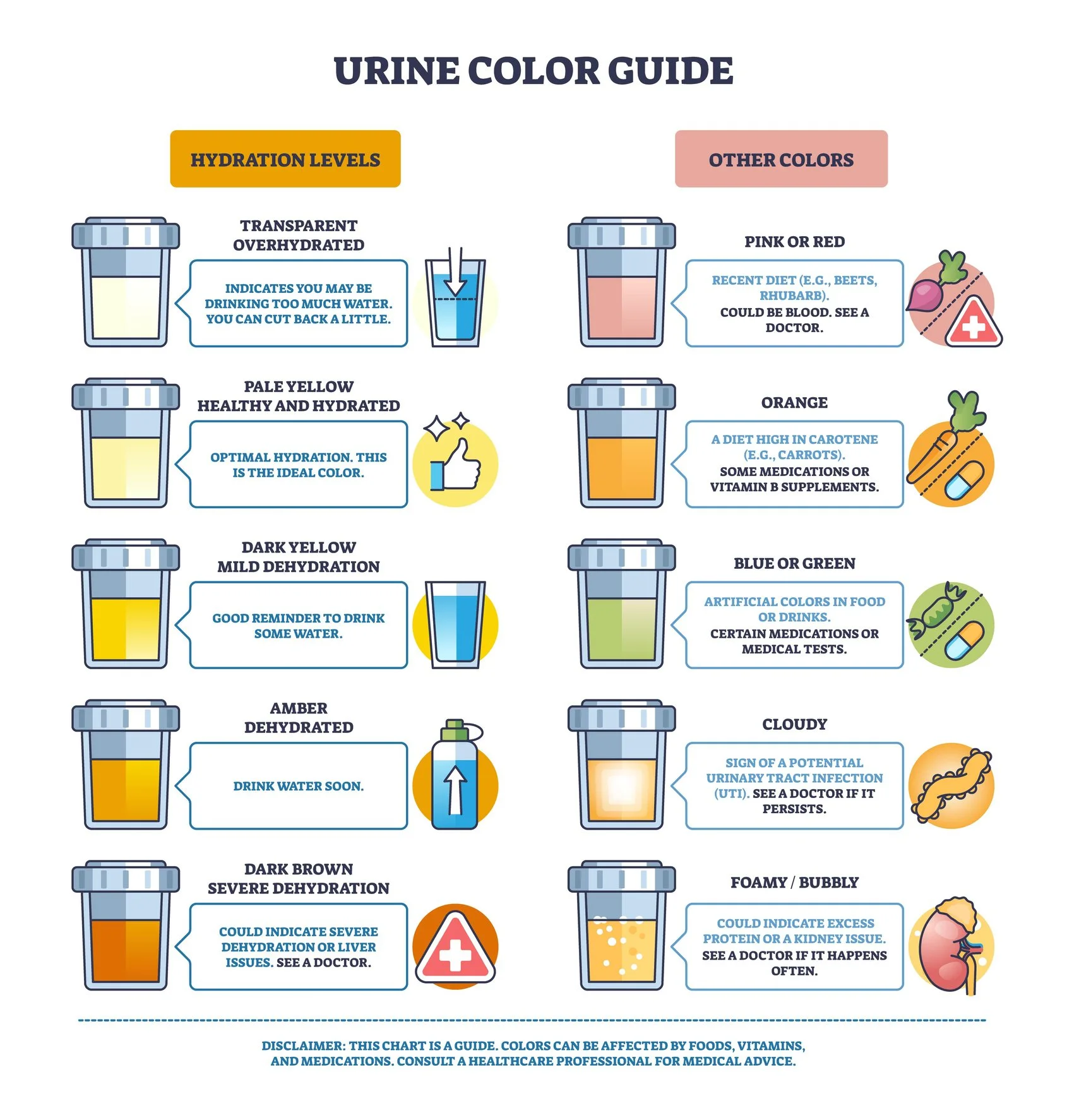
Here is something worth knowing: many patients who visit our clinic — particularly women — quietly slip away to use the restroom before or after their appointment. When asked directly about their urinary habits, a surprising number have no idea anything is wrong. They have simply normalized something that deserves attention.
So let's talk about urination — what is normal, what isn't, and what classical Korean medicine has to say about the patterns that fall in between.
What Is Normal Urination?
According to general medical guidelines, a healthy adult urinates approximately 5 to 7 times per day, with a total daily urine output of around 2,500cc (roughly 2.5 liters). Of course, this varies based on fluid intake, diet, and any underlying conditions or medications.
A few things that are often overlooked:
Caffeine matters. Coffee, tea, energy drinks, and sodas all increase urinary frequency. If you consume multiple caffeinated beverages daily and urinate frequently, the two are likely connected.
Medications affect output. Diuretics, certain blood pressure medications, and other pharmaceuticals can significantly alter urinary patterns. Always consider what you are taking.
Nighttime urination is not normal. Waking once or more during the night to urinate — a condition called nocturia — is not simply a sign of getting older. In Korean medicine, the body should consolidate fluids during sleep. Nocturia points to an underlying imbalance that deserves investigation, whether related to kidney function, sleep quality, fluid metabolism, or hormonal factors.
The classical Korean medical text Bangnyakhabpyeon (방약합편) — a comprehensive compendium of herbal formulas compiled in the late Joseon dynasty — categorizes urinary disorders into five distinct patterns. Each has a different root cause, and each calls for a different herbal approach. Understanding which pattern applies to you is the starting point for effective treatment.
The Five Urinary Patterns in Classical Korean Medicine
① Yo-bulli (尿不利) — Difficult or Incomplete Urination
What it looks like: Urine flows with difficulty. The stream may be weak, start-stop, or feel incomplete. The urine is often dark yellow or cloudy.
Root causes in Korean medicine: Bladder damp-heat (방광습열), lung heat congestion (폐열옹성), middle qi sinking (중기하함), liver qi stagnation (간울기체), decline of mingmen fire (명문화쇠), or urethral obstruction (요도폐색).
In plain terms: the body's heat and dampness have accumulated in the lower burner, impairing the bladder's ability to release urine smoothly. Think of it as a drainage system that has become obstructed by heat and inflammation.
Classical herbal formulas used:
Manjeon-moktong-tang (萬全木通湯) — For bladder heat causing difficult urination with yellow-colored urine. Clears heat from the bladder and promotes smooth flow.
Dojuk-san (導赤散) — For urinary difficulty caused by heat in the small intestine. When combined with Saryeong-san, it becomes "Ihyeol-tang," which addresses heat congestion in the upper stomach and mouth sores alongside urinary difficulty.
Cheongsim-yeonja-eum (淸心蓮子飮) — For red, burning urine accompanied by dry mouth, restlessness, and thirst. The pattern here involves heart fire rising upward while the lower burner struggles with heat-dampness.
Samul-tang (四物湯) — The foundational blood-nourishing formula. Used when blood heat or blood deficiency underlies the urinary difficulty. Seasonal modifications are applied: double the Cnidium rhizome in spring, Paeonia root in summer, Rehmannia in autumn, and Angelica root in winter.
② Yo-buttong (尿不通) — Complete Urinary Retention or Severe Obstruction
What it looks like: Urine does not flow at all, or comes out only drop by drop. This is more severe than simple difficulty — it represents significant obstruction or functional shutdown of the bladder.
Root causes: Accumulated heat in the bladder, qi and blood stagnation, phlegm obstruction, yin deficiency with fire, essence depletion, or — in the elderly — yang decline.
This pattern covers a spectrum of causes, which is why the classical texts offer numerous formulas depending on the specific underlying mechanism.
Classical herbal formulas used:
Paljeong-san (八正散) — For urinary retention caused by accumulated heat in the bladder. The primary formula for bladder inflammation, urethritis, and heat-type urinary blockage.
Yugong-san (禹功散) — Reserved for cases where other approaches have failed. A stronger formula for stubborn urinary retention.
Daebuncheongeom (大分淸飮) — For urinary obstruction with jaundice and blood in the urine — all caused by heat accumulation. Adding Artemisia (인진) is indicated when jaundice is present. A modified version called "Sobuncheongeom" removes certain herbs and addresses dampness blocking fluid metabolism.
Bojungikgi-tang (補中益氣湯) — For urinary obstruction rooted in middle qi deficiency and exhaustion. This is the formula for the patient whose retention comes not from heat but from a body too depleted to push fluids through. Used when overwork or poor diet has collapsed the center.
Jashinhwan (慈腎丸) — Specifically for urinary retention WITHOUT thirst — a key distinguishing feature. Made from Phellodendron, Anemarrhena, and cinnamon bark in powder form. The absence of thirst points to a cold-type obstruction rather than a heat pattern.
Palmul-tang (八物湯) — For dual qi and blood deficiency underlying urinary blockage. Also called "Paljin-tang." Used when the body lacks both the energy and the blood to support proper urinary function.
Jaeum-ganghwa-tang (滋陰降火湯) — For yin deficiency with fire rising: night sweats, afternoon fever, cough, blood-tinged sputum, and wasting. The fire pattern driving urinary difficulty here comes from the inside — depleted yin allowing heat to rise unchecked.
Palmiwon (八味元) — For kidney water deficiency and mingmen yang decline. The foundational formula for cold-type urinary retention in patients with depleted kidney essence — cold lower back, weak knees, fatigue, and frequent or difficult urination from constitutional depletion.
Yukmi-jihwang-won (六味地黃元) — For elderly patients with umbilical and lower abdominal cramping with urinary retention (노인전포), a pattern of kidney yin depletion.
Samchul-eum (蔘朮飮) — For urinary retention during pregnancy (임부전포). A specialized formula used when pregnancy itself is causing urinary obstruction.
③ Giheo-yosap (氣虛尿澁) — Qi Deficiency Causing Urinary Difficulty
What it looks like: Urination is sluggish, uncomfortable, or unsatisfying — but not completely blocked. The patient often feels a vague fullness or pressure in the lower abdomen. Fatigue, shortness of breath, and poor appetite are usually present alongside the urinary symptoms.
Root cause: Middle qi deficiency. The body simply lacks the energy to drive fluids through the urinary tract efficiently.
Classical herbal formula:
Bojungikgi-tang (補中益氣湯) — The master formula for middle qi deficiency. Lifts and consolidates the center, restoring the body's capacity to manage fluids. This formula addresses the underlying depletion rather than the urinary symptom directly.
④ Gwangyeok (關格) — Nausea with Urinary Retention (Upper and Lower Obstruction)
What it looks like: A severe pattern involving simultaneous nausea or vomiting (upper blockage) and inability to urinate (lower blockage). The body's fluids cannot move in either direction. This represents a serious disruption of the body's middle pivot.
Root cause: Phlegm obstructing the middle burner, or accumulated bladder heat creating a blockage that backs up throughout the system.
Classical herbal formulas:
Jichuk-ijin-tang (枳縮二陣湯) — The primary formula for gwangyeok pattern. Moves phlegm stagnation in the middle burner to restore the flow between upper and lower. Used specifically when phlegm is the underlying cause of the bidirectional blockage.
Paljeong-san (八正散) — When the obstruction is driven by bladder accumulated heat rather than phlegm.
⑤ Bulgeum (不禁) — Urinary Incontinence and Frequency
What it looks like: Urination that cannot be controlled — frequent, urgent, dribbling, or leaking. In severe cases the patient may urinate over 100 times per day. This pattern is also called "불금" — literally "cannot be restrained."
Root causes: Spleen-lung deficiency (비폐허) or liver-kidney deficiency (간신허). The organs responsible for holding and transforming fluids have become too weak to consolidate urine.
This pattern is extremely common in elderly patients, postpartum women, and anyone who has experienced prolonged depletion — and it is one of the most underdiagnosed conditions we see in clinical practice.
Classical herbal formulas:
Chukcheonhwan (縮泉丸) — The classic formula for bladder qi insufficiency causing extreme urinary frequency — documented in classical texts for patients urinating over 100 times per day. Warms the bladder and strengthens the qi to consolidate urine.
Samgi-tang (蔘芪湯) — For qi deficiency with urinary incontinence. Adding aconite (부자) adapts the formula for elderly patients with more significant yang decline.
Bojungikgi-tang (補中益氣湯) — Lifts the middle qi and consolidates prolapsed functions, including urinary leakage from qi sinking.
Yukmi-jihwang-tang (六味地黃湯) — For kidney yin deficiency underlying urinary frequency and incontinence.
Ijung-tang (理中湯) — For spleen-lung deficiency (비폐허): spontaneous diarrhea without thirst, cold signs, and general yang deficiency. Addresses the spleen's failure to transform and consolidate fluids.
Guibi-tang (歸脾湯) — For forgetfulness, palpitations, and anxiety from overwork damaging the heart and spleen (우사노상심비). Used when emotional and mental exhaustion is depleting the organs responsible for fluid consolidation.
Ugwi-eum (右歸飮) — For liver-kidney deficiency (간신허) with yang deficiency and yin excess. A warming formula for patients whose incontinence stems from deep constitutional decline — cold body, weak lower back, and impaired yang function.
Palmiwon (八味元) — For kidney water deficiency with yang decline. Warms the kidney yang, strengthens the lower back, and consolidates fluid metabolism in deficient patients.
Putting It All Together: Why Pattern Diagnosis Matters
What makes classical Korean medicine's approach to urinary disorders so distinctive is its refusal to treat the symptom in isolation. The same symptom — difficulty urinating — can arise from completely opposite root causes. One patient may have too much heat accumulating in the bladder. Another may have too little qi to push fluids through. A third may have yin deficiency allowing fire to rise from below. Each requires a completely different treatment.
This is why the same herbal formula will help one patient dramatically and do nothing for another — or why Western treatments for urinary symptoms often provide temporary relief without resolving the underlying pattern.
A few practical principles that classical texts and clinical experience reinforce:
Heat-type patterns (dark, burning, painful, urgent urination; thirst; dark tongue) — require heat-clearing, dampness-draining formulas like Paljeong-san or Dojuk-san.
Deficiency-type patterns (weak stream, fatigue, cold body, pale tongue, frequent nighttime urination) — require tonifying formulas like Palmiwon, Yukmi-jihwang-tang, or Bojungikgi-tang.
Mixed patterns (deficiency with some heat, or qi deficiency with dampness) — require compound formulas that address both dimensions simultaneously.
Emotional and mental factors — overwork, anxiety, and chronic stress (captured by formulas like Guibi-tang) genuinely deplete the organs responsible for urinary function. The connection between psychological stress and bladder dysfunction is not just modern medicine's discovery — it has been recognized in classical Korean medicine for centuries.
When to Seek Treatment
Consider a consultation if you experience any of the following:
Urinating more than 8 times per day without excessive fluid intake
Waking at night to urinate (even once regularly)
A weak, slow, or incomplete urine stream
Burning or discomfort during urination
Urgency that is difficult to control
Leaking with coughing, sneezing, or physical exertion
Lower abdominal fullness or pressure around the bladder
Urine that is consistently very dark yellow, cloudy, or blood-tinged
Any of these patterns can be addressed through classical Korean herbal medicine, often in combination with acupuncture. The goal is not to suppress the symptom but to identify and correct the root cause — so that the body can regulate itself without continued intervention.
At Raah Acupuncture
At Raah Acupuncture in Koreatown, Los Angeles, Justin Chung L.Ac. Dipl. O.M. (NCCAOM) is a California licensed acupuncturist and herbalist with graduate training in classical Korean and Chinese herbal medicine. Custom herbal decoctions are formulated specifically for each patient's individual pattern following a thorough consultation.
If you have been dealing with urinary symptoms that conventional approaches have not fully resolved, a classical herbal medicine consultation may offer the root-level treatment you have been looking for.
Call us at 323-422-4964, email contact@raahacupuncture.com, or visit raahacupuncture.com/contact to schedule a consultation.
3407 West 6th Street, Suite 702 · Los Angeles, CA 90020 · Koreatown, Los Angeles
This article references classical Korean herbal formulas from the Bangnyakhabpyeon (방약합편), a foundational compendium of East Asian herbal medicine. All herbal prescriptions at Raah Acupuncture are individualized and administered by a licensed acupuncturist and herbalist (L.Ac., Dipl. O.M.). This post is for educational purposes only and does not constitute medical advice. These statements have not been evaluated by the Food and Drug Administration.