
Before asking what a fever is, a 1613 Korean medical text asks a different question first:
When does it come?
That sounds like a detail. In this system it's the whole diagnosis. The chapter on fire — Korean medicine's physics of heat, and where its account of hot flashes, night sweats, and low-grade fevers lives — sorts heat by the clock before it sorts it by anything else.
We translated this chapter in full: Fire — full translated chapter.
The rule
The classical framework holds that the body's defensive Qi makes fifty circuits a day — twenty-five through the Yang aspect while it's light, twenty-five through the Yin while it's dark. So:
> Daytime heat travels the Yang's twenty-five circuits... Night heat travels the Yin's twenty-five.
Which yields a treatment rule that a practitioner can apply in about ten seconds:
Heat that comes by day, quiet by night — the heat is in the Qi aspect. Treated with the bupleurum family: coursing, moving, clearing.
Heat that comes by night, quiet by day — the heat is in the Blood aspect. Treated with the Four Substances family: building and cooling the blood, not moving it.
Heat day and night both — both aspects; the two families joined.
The same logic gets more granular:
> Heat effusing at daybreak lies in the Yang's circuit, governed by Lung Qi... Tidal heat at late afternoon lies in the Yin's circuit, governed by Kidney Qi.
Morning heat and late-afternoon heat are, in this system, different conditions requiring different formulas — a distinction I use nearly every week in the clinic.
And a second timing question
Alongside when, there's a question about punctuality:
> Tidal heat that keeps an hour is internal damage, and is vacuity. Tidal heat that keeps no hour is external contraction, and is repletion.
A fever arriving reliably at the same time each day points to depletion — this chapter's territory. A fever with no schedule points to an invasion, and belongs to the Cold chapter next door.
So one question at intake — does it come at the same time? — routes the entire case.
Where this matters most: the menopausal transition
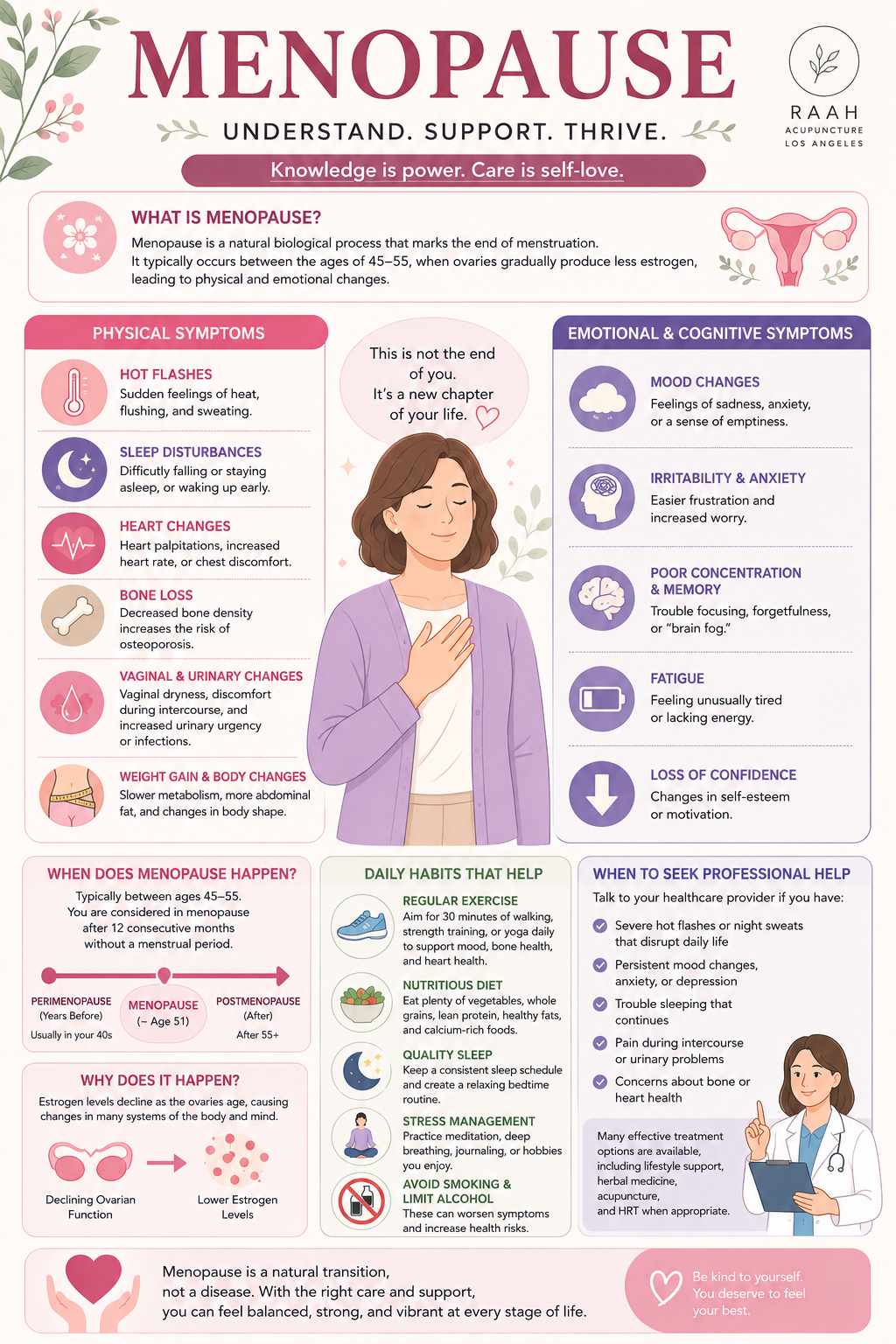
This framework maps onto the perimenopausal and menopausal picture unusually well.
The classical pattern name is 음허화동 (陰虛火動), Yin vacuity with fire stirring, and the chapter's description of it reads like a symptom questionnaire: tidal heat that keeps an hour, night sweats, a fluttering heart, dry mouth without much thirst, and heat in the palms and soles.
Its explanation of the mechanism is one of the finest passages of physiology in the classical canon: when essence-spirit gallops outward and craving knows no measure, the Yin wears thin, and the Yang, having nothing left to adhere to, drifts loose between flesh and surface — heat with no address.
That is a description of a system that has lost its anchor rather than one that has too much fire. And it explains why the treatment is not simply cooling. The chapter's central distinction:
Some heat is an excess to be drained. Some heat is what burning looks like when the fuel is running out. The second kind can't be fixed by cooling alone. It has to be refilled.
The flagship formula for it, Cheongrijagam-tang 淸离滋坎湯, takes its name from the I Ching: clear the hexagram of fire, enrich the hexagram of water. And notably, the chapter prescribes in three stages — decoctions for the acute period, pastes and pills to consolidate, and a maintenance formula whose stated job is gathering in the achievement and guarding what follows. A staged plan for a transition that takes years, written in 1613.
Two bedside signs worth knowing
The flipped hand. Heat felt on the back of the hand suggests an invasion. Heat felt in the palm suggests depletion. Two seconds, no equipment.
The mouth. In replete heat, there is real thirst and the person drinks. In vacuous heat, the mouth is dry but does not ask for water. Patients often describe this precisely once you ask.
What this doesn't replace
Persistent or measured fever, drenching night sweats, unexplained weight loss, or new heat symptoms with fatigue need a medical workup — infection, thyroid disease, and other causes are on that list, and some of them matter urgently. This framework is for sorting a pattern once those have been considered, and for the very common situation where everything has been ruled out and the person still feels hot at 4 p.m. every day.
Read more: Menopause, Hot Flashes & Night Sweats
---
Frequently asked questions
Why do I wake up hot at 3 a.m.?
In this framework, night-predominant heat is Blood-aspect heat, treated by nourishing and cooling rather than by clearing. Practically it's the most common presentation in perimenopause. Persistent drenching night sweats should be evaluated medically first.
Is afternoon fatigue with feeling hot a real pattern?
Yes — late-afternoon tidal heat is one of the named patterns in this chapter, and it's associated with depletion rather than infection. It shows up commonly in the chronically overworked and in the postpartum year.
Can acupuncture help hot flashes?
Hot flashes and night sweats are among the more commonly treated complaints in acupuncture practice, and many patients use it alongside or instead of hormone therapy depending on their situation. Herbal formulas do the slower structural work.
Does this mean I shouldn't take hormone therapy?
Not at all. HRT is a decision for you and your physician. This care is often used alongside it — to manage what HRT doesn't fully cover, or to ease the transition on or off it.
What's the difference between hot flashes and a fever?
A fever is a measured elevation in body temperature. Hot flashes are a vasomotor sensation without a temperature rise. The classical framework treats the sensation as diagnostic in its own right — which is why patients whose thermometers read normal are still describing something real.
---
Eui Young (Justin) Chung, L.Ac., Dipl. O.M. practices at Raah Acupuncture in Koreatown, Los Angeles, and is the translator of the ongoing English edition of the Donguibogam at formulas.raahacupuncture.com.
---