
You went in for a routine appointment. The baby is breech. Someone mentioned the word "cesarean," you were told to come back in two weeks, and now it is eleven at night and you are reading everything you can find.
That is how most people arrive at this page. So let's be efficient about it.
Moxibustion is a real option, it is worth trying, the evidence behind it is genuine but more modest than most acupuncture websites will tell you, and the timing matters more than almost anything else you will read tonight. If your baby is breech and you are somewhere between 33 and 35 weeks, this is the window. If you are at 37 weeks, your options are narrower and different.
Here is an honest account of what this treatment is, what the research actually shows, and what to do next.
What "Breech" Actually Means
A breech baby is positioned bottom-down or feet-down instead of head-down. Earlier in pregnancy this is completely normal — there is space, and babies move constantly. Most turn head-down on their own by the early third trimester.
At term, roughly three to four percent of babies remain breech. That is when it becomes a clinical decision rather than a wait-and-see situation, because <cite index="14-1">a baby coming bottom first can have more difficulty being born, and a cesarean section is often suggested</cite>.
So the goal is straightforward: give the baby the best possible chance to turn on its own, while there is still room to do it.
The Timing Window: Why 33 to 35 Weeks
This is the part most people wish they had known a week earlier.
Two things are working against each other as pregnancy progresses. Early on there is plenty of room to turn, but the baby may flip right back. Later there is less chance of flipping back, but there is also less room to turn at all.
The window where both factors are favorable is roughly 33 to 35 weeks. The clinical trials that showed the clearest results started treatment in exactly that range — <cite index="15-1">moxibustion combined with acupuncture, given twice weekly from 33 to 35 weeks' gestation</cite>.
It can still be attempted at 36 or 37 weeks, and we do treat people at that stage. But the odds decline as space runs out, and by then you are usually also making decisions about external cephalic version.
If you have just been told your baby is breech and you are anywhere in the early thirties of weeks, come in this week rather than next. That single decision affects your odds more than anything else discussed on this page.
What Moxibustion Is
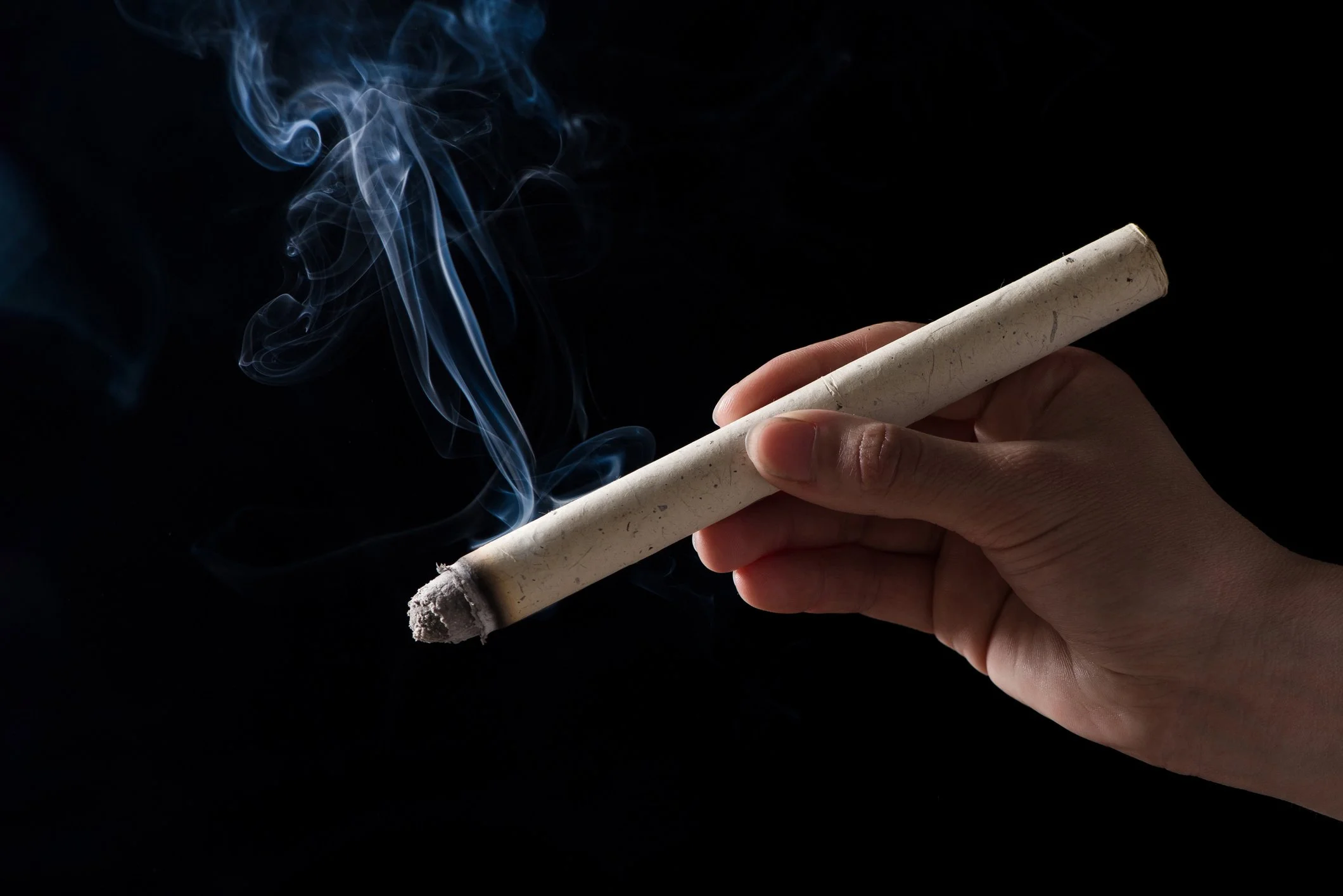
Moxibustion is the burning of dried mugwort — a herb — near the skin to drive warmth into a specific point. It is one of the oldest therapies in East Asian medicine, and in Korean medicine it is called ssukddeum (쑥뜸).
For breech presentation, one point is used: <cite index="14-1">Bladder 67 (BL67), known in Chinese as Zhiyin and located at the tip of the fifth toe</cite>. In Korean it is 지음 (至陰). It sits at the outer corner of the little toenail, on both feet.
No needles are involved. Nothing touches your abdomen. A moxa stick is held close enough to the toe to produce steady, penetrating warmth — not close enough to burn — for roughly fifteen to twenty minutes per foot.
Most people feel the baby become noticeably more active during the session or shortly after. That increase in fetal movement is the working theory behind why it helps: warmth at the point appears to stimulate activity and circulation, and the baby does the turning itself. The treatment does not push or manipulate anything.
What the Research Actually Shows
This is where we are going to be more careful than most clinics are, because you are pregnant and you deserve straight information rather than marketing.
The most rigorous assessment available is the Cochrane systematic review, updated in 2023. <cite index="19-1">It includes thirteen studies covering 2,181 women.</cite> Here is what it found.
On whether the baby ends up head-down: <cite index="19-1">There is moderate-certainty evidence that moxibustion combined with usual care probably reduces the chance of the baby still being in a non-cephalic position at birth.</cite> This is the central finding, and it is the reason we offer this treatment. "Moderate certainty" is a meaningful result in obstetric research.
On avoiding a manual turning procedure: <cite index="19-1">The evidence about whether it reduces the need for external cephalic version is uncertain.</cite> You will find clinic websites claiming otherwise. We are not going to.
On avoiding a cesarean: <cite index="19-1">Moxibustion plus usual care probably results in little to no difference in the cesarean section rate.</cite> This surprises people, and it deserves explanation rather than burial. Mode of birth is determined by many factors beyond presentation, and the trials did not show a clear effect here.
On labor: <cite index="19-1">One study provided moderate-certainty evidence that moxibustion plus usual care probably reduces the use of oxytocin before or during labor.</cite>
On safety: <cite index="19-1">Adverse events were inadequately reported in most of the trials.</cite> This is a genuine limitation. It does not mean harm was found — it means the studies did not track it well enough to draw firm conclusions. In practice, moxibustion at BL67 is a non-invasive treatment applied to a toe, and the clinical risk profile is low, but we would rather tell you what the research does and does not establish.
The honest summary: there is reasonable evidence that this improves the chance your baby turns. There is not good evidence that it changes how you give birth. It is low-risk, the window is short, and it is worth trying early — but it is not a guarantee, and anyone who tells you it is has stopped reading at the headline.
What Treatment Looks Like Here
Your first visit runs about an hour. We go through your pregnancy history, confirm the presentation and gestational age from your records, and ask what your OB or midwife has already said. Then we treat — moxibustion at BL67 on both feet, usually alongside acupuncture points selected for your overall pattern.
Some patients feel movement on the table. Some feel it that evening. Some feel nothing unusual, and the baby still turns.
Between visits, you continue at home. This matters more than the in-clinic sessions, because consistency is what drives the result. We teach you — or better, your partner — how to hold the moxa stick, how far from the toe, how long, and what to watch for. You will do it daily.
A typical course runs about ten days, with in-clinic visits and daily home treatment. If the baby turns, you stop. We will ask you to confirm the position with your OB or midwife rather than relying on how it feels.
Bring your prenatal records to the first visit, and tell us if you have an ECV already scheduled. That changes the timeline we are working with.
Safety and When We Won't Treat
Please keep your OB or midwife informed that you are doing this. Most in Los Angeles are familiar with moxibustion for breech and many actively suggest it. We are not asking you to choose between approaches — this works alongside your prenatal care, not instead of it.
Tell us if any of the following apply, because some of them mean we hold off or coordinate with your provider first:
Placenta previa or a low-lying placenta
Carrying twins or more
Previous uterine surgery, including a prior cesarean
Preeclampsia or high blood pressure in this pregnancy
Vaginal bleeding, leaking fluid, or ruptured membranes
Preterm labor, or a history of it
Any complication your OB has flagged
Reduced fetal movement — this needs your OB today, not us
Moxa produces smoke and a strong herbal smell. We use ventilation and smokeless options where needed, and if you have asthma or the smell is intolerable during pregnancy, tell us and we will adjust.
If It Doesn't Work
Sometimes it doesn't, and you should know your path in advance rather than discovering it at 38 weeks.
External cephalic version (ECV) is the standard next step — an obstetrician manually turning the baby from outside the abdomen. <cite index="17-1">It is usually performed at or after 37 weeks.</cite> Many patients do moxibustion first and ECV after, and there is no conflict between the two.
Postural techniques are widely recommended — the forward-leaning inversion, breech tilt, and similar positions. Be aware that <cite index="17-1">a Cochrane review found insufficient evidence to support postural management for changing breech presentation</cite>. They are low-risk and many people find them worth doing, but the evidence base is thinner than for moxibustion.
Planned cesarean or vaginal breech birth are the remaining options, and those conversations belong with your obstetrician or midwife, not with us.
Turning breech is not the only reason to see us during pregnancy, either. Many patients continue afterward for back and pelvic pain, sleep, anxiety, and labor preparation.
Frequently Asked Questions
Does it hurt? Is it safe for the baby? There are no needles involved in the moxibustion itself, and nothing is applied to your abdomen. You feel warmth at the toe, sometimes a pleasant deep heat. The treatment is non-invasive. As noted above, the trials did not track adverse events thoroughly enough for a definitive safety conclusion, but the intervention is warmth applied to a point on the foot.
How soon might the baby turn? Some turn within the first few days. Others take the full ten-day course. Some do not turn at all. Confirm any change with your provider rather than going by sensation.
I'm 37 weeks. Is it too late? Not necessarily, but the odds are lower and you should be having the ECV conversation with your OB in parallel. Call us and we will tell you honestly whether we think it is worth your time at your stage.
Can I just do it at home without coming in? You can buy moxa sticks online, and plenty of people do. What you get from a visit is confirmation that the point is located correctly, technique that avoids burns, a check on whether anything in your pregnancy is a reason to hold off, and treatment tailored to your overall pattern rather than the point alone. If cost is the obstacle, tell us — that is a conversation worth having rather than a reason to skip care.
Is it covered by insurance? It depends on your plan. We accept most major insurance and will verify your acupuncture benefit before your first visit so there are no surprises. If moxibustion is not covered under your plan, we will tell you what it costs before we do it.
Do I need to stop seeing my OB? No. Absolutely not. This works alongside standard prenatal care. Keep every appointment you have.
If Your Baby Is Breech, the Clock Is the Thing
You do not have unlimited time to research this. If you are between 33 and 35 weeks, the most useful thing you can do tonight is book an appointment for this week.
At Raah Acupuncture in Koreatown, Los Angeles, moxibustion for breech presentation is one of the most common reasons patients are referred to us. We treat alongside your OB or midwife, we will tell you honestly whether your timing still makes it worthwhile, and we will teach you to continue the treatment at home.
Call 323-422-4964, email contact@raahacupuncture.com, or book at raahacupuncture.com/book.
3407 West 6th Street, Suite 702 · Los Angeles, CA 90020 · Koreatown
Serving Koreatown, Mid-Wilshire, Hancock Park, Silver Lake, Downtown LA, and greater Los Angeles.
Raah Acupuncture Inc. is a licensed acupuncture and herbal medicine practice in Koreatown, Los Angeles. Treatment is provided by Eui Young (Justin) Chung, L.Ac., Dipl. O.M. (NCCAOM). This article is for educational purposes and is not medical advice. It is not a substitute for prenatal care. Always consult your obstetrician or midwife about your pregnancy, and seek immediate care for reduced fetal movement, bleeding, leaking fluid, or signs of preterm labor.