
If you can't sleep in summer, it's because heat disrupts the two things rest depends on: your body's nightly temperature drop, and — in Korean medicine terms — a calm Heart. Summer is the season of the Heart and the fire element, and your heart doesn't like overheating; when heat agitates the Heart and the mind it houses, sleep is the first thing to break down. Acupuncture for insomnia helps by settling that heat and calming the overactive nervous system so your body can cool, quiet, and rest again.
That's the short answer. The longer one is worth your time, because it changes how you think about summer health altogether. In the Korean medical tradition I practice at Raah Acupuncture in Los Angeles Koreatown, taking care of yourself in summer is taking care of your Heart — the physical organ, and the shen (spirit or mind) that classical medicine says resides within it. Sleepless July nights aren't a random nuisance. They're your Heart telling you it's running hot.
Here in LA, the message comes through loudly. Koreatown apartments trap heat, older buildings lack central air, and the urban heat island keeps our neighborhoods warm long after sunset. By late July, my patients describe the same pattern: exhausted all day, wired at night, waking at 2 a.m. with a racing mind and a hot chest. Let's look at why — through modern sleep science and classical Korean medicine — and what you can do about it, starting tonight.
The Sleep Science: Your Body Sleeps by Cooling Down
Most people assume sleep is triggered by darkness or fatigue. Those matter, but the more precise trigger is thermal. In the hour or two before sleep, your core body temperature begins to fall, and your body sheds that heat outward through the skin of your hands and feet. This peripheral warming is not a side effect — it is the mechanism.
Research on the temperature dependence of sleep describes this clearly: sleep onset coincides most strongly with the steepest rate of decline in core body temperature, and vasodilation in the hands and feet is one of the best physiological predictors that sleep is about to begin (Harding et al., Frontiers in Neuroscience, 2019). Deep, slow-wave sleep is most likely to occur while the core is actively cooling — and notably, that same deep-sleep state is when the heart itself gets its nightly rest, with heart rate and blood pressure dipping to their lowest levels.
Now picture a hot LA night. When the air around you is warm, your skin can't offload heat efficiently, so your core temperature stays elevated. The cooling signal that normally ushers you into sleep is muted. You lie there feeling "tired but wired," and even when you drift off, the sleep is lighter and more fragmented — which means less of that restorative low-heart-rate deep sleep.
This isn't just theory. Large-scale climate research has linked warmer nighttime temperatures to measurable increases in reported insufficient sleep, with the effect strongest during summer and among older adults and lower-income households — exactly the people with the least reliable air conditioning (Obradovich et al., Science Advances, 2017). In a dense, unevenly cooled city like Los Angeles, that population is large.
Modern science, in other words, has arrived at something Korean medicine stated plainly centuries ago: heat and rest are opponents, and the battleground is the Heart.
The Korean Medicine View: Summer Belongs to the Heart
In Korean and East Asian medicine, each season corresponds to an organ system and an element. Summer is the season of the Heart and the fire element — the peak of yang: active, warming, expansive, upward-moving energy. That correspondence isn't decorative. It's a clinical warning: the Heart is the organ most easily pushed out of balance in summer, because fire feeds fire. Your heart doesn't like overheating.
Sleep, in this tradition, is governed largely by the Heart, which houses the shen — often translated as "spirit" or "mind." For sleep to come, the shen must settle and be anchored. Heat rises, as heat does, and when excess heat climbs into the chest it disturbs the Heart and stirs the shen so it cannot rest. Patients describe this state precisely: a racing mind at night, vivid or agitated dreams, waking flushed with a hot chest, palpitations, restlessness even when the body is bone-tired.
So when I say summer health is Heart health, I mean it in both registers at once. Caring for your Heart in summer means protecting the organ from thermal stress and protecting the mind from the agitation that steals your sleep. They are, in this medicine, the same project.
Two Common Summer Patterns
Not everyone's summer insomnia looks the same, and this is where classical diagnosis earns its keep.
Excess heat disturbing the Heart. The acute, "loud" picture: irritability, a red face, thirst, a bitter taste, restlessness, and difficulty falling asleep because the mind simply won't quiet.
Yin deficiency with empty heat. Subtler, and very common in people who are depleted — from overwork, chronic stress, aging, or too many summers of poor sleep. Yin is the body's cooling, moistening, restorative aspect; when it's deficient, there isn't enough coolant to balance the body's normal warmth, and a low-grade "empty heat" flickers up at night. The classic signs: waking around 2–4 a.m. unable to fall back asleep, night sweats, warm palms and soles, a dry mouth, a mind that hums rather than roars. Summer heat depletes yin further, which is why some people feel their sleep steadily unravel as the season wears on.
These patterns function as a clinical map that tells me where to needle and how to treat — whether to clear excess fire from the Heart or to nourish yin and gently anchor the shen. I practice Saam acupuncture, a distinctly Korean lineage that works through five-element point combinations rather than simply needling the site of complaint. For summer insomnia, that usually means treating the imbalance driving the heat, not just sedating the symptom.
Does Acupuncture Actually Help You Sleep? What the Evidence Says
I try to be honest about what the research does and doesn't show, because you deserve that.
The evidence for acupuncture for insomnia is genuinely encouraging, particularly for the subjective experience of sleep. A 2025 systematic review and meta-analysis of randomized controlled trials in chronic insomnia found that acupuncture significantly improved Pittsburgh Sleep Quality Index (PSQI) scores compared with sham acupuncture, with a mean difference of roughly −2.6 points (Frontiers in Neurology, 2025). It also improved insomnia severity and sleep efficiency and reduced time awake after sleep onset by roughly 18 minutes. Manual acupuncture showed a larger effect than electroacupuncture in that analysis.
Other reviews echo this. A meta-analysis comparing real acupuncture against sham or placebo needling likewise found meaningful improvements in sleep quality, supporting that the effect is more than expectation alone (Kim et al., PubMed, 2020).
The honest caveats: many trials are modest in size or quality, objective measures like total sleep time show weaker effects than subjective ratings, and "acupuncture" covers a range of techniques. It is not a magic switch, and I won't tell you it is. But for a low-risk treatment with a strong safety record, the signal for improved sleep quality is real and consistent.
Mechanistically, this fits everything above. Acupuncture appears to shift the autonomic nervous system away from sympathetic "fight or flight" dominance toward the parasympathetic "rest and digest" state — the same physiological gear that slows the heart, dilates peripheral blood vessels, and lets the body shed heat. In other words, it helps restore the very cooling-and-calming cascade that summer heat disrupts. The classical language — clearing heat from the Heart, anchoring the shen — and the modern language — downshifting the autonomic nervous system — are describing the same door from two sides.
Eating for Your Heart in Summer: Cherries, Watermelon, and Cooling Habits
Much of Korean medicine is preventive and dietary. In summer, that means eating to cool the body and nourish the Heart rather than adding fuel to the fire.
Cherries: the Heart's summer fruit
If I had to pick one everyday food for Heart season, it would be cherries. Classically, red foods resonate with the fire element and the Heart — and cherries arrive at their peak exactly when the Heart needs support, which is the kind of seasonal logic Korean medicine is built on. Modern research adds an intriguing sleep angle: tart cherries are a natural dietary source of melatonin, and a randomized placebo-controlled trial found that tart cherry juice concentrate raised circulating melatonin and modestly improved sleep time and efficiency (Howatson et al., European Journal of Nutrition, 2012). A bowl of fresh cherries in the evening, or tart cherry juice in place of a nightcap, is a small habit that serves both the classical Heart and the modern one.
Watermelon: my go-to for overheating
When a patient comes in heat-exhausted — flushed, drained, headachy, dehydrated from an LA heat wave — my first food recommendation is almost always watermelon. In Korean medicine it is the classic summer-heat clearing food: intensely cooling, moistening, and gently replenishing the fluids that heat burns off. It clears heat through urination while rehydrating you, which is exactly what an overheated body needs. If you've spent an afternoon in the sun and feel wrung out, watermelon before anything else. (For actual heat stroke — confusion, fainting, a body that has stopped sweating — that's an emergency: call 911 first, eat watermelon later.)
Round out the plate — and avoid adding heat
- Other cooling foods: cucumber, mung bean (nokdu), barley tea (boricha), pear, and leafy greens.
- Go easy at night on heat-generating foods: alcohol (it fragments sleep and adds internal heat), heavy spice, deep-fried food, excess coffee, and large late meals.
- Hydrate steadily through the day rather than gulping water right before bed.
Cool the body, calm the shen
- Cool your feet and hands, not just the room. A lukewarm shower before bed — or a warm one an hour earlier, for the rebound cooling afterward — helps trigger the temperature drop that starts sleep.
- Move air across your skin. No AC? Cross-ventilate in the evening, run a fan, and choose breathable cotton or linen bedding.
- Protect a wind-down hour. Dim screens and lights; slow, long exhales nudge you toward the parasympathetic, heat-shedding state.
- Keep consistent sleep and wake times to strengthen your natural evening temperature decline.
Sambok (삼복): How Koreans Fight the Hottest Days of Summer
Korean tradition doesn't just acknowledge summer heat — it puts it on the calendar. The three hottest stretches of the traditional summer are called sambok (삼복): chobok (초복), the beginning; jungbok (중복), the middle; and malbok (말복), the end. In 2026 they fall on July 15, July 25, and August 14 — so as this post goes up, we're between chobok and jungbok, in the thick of it.
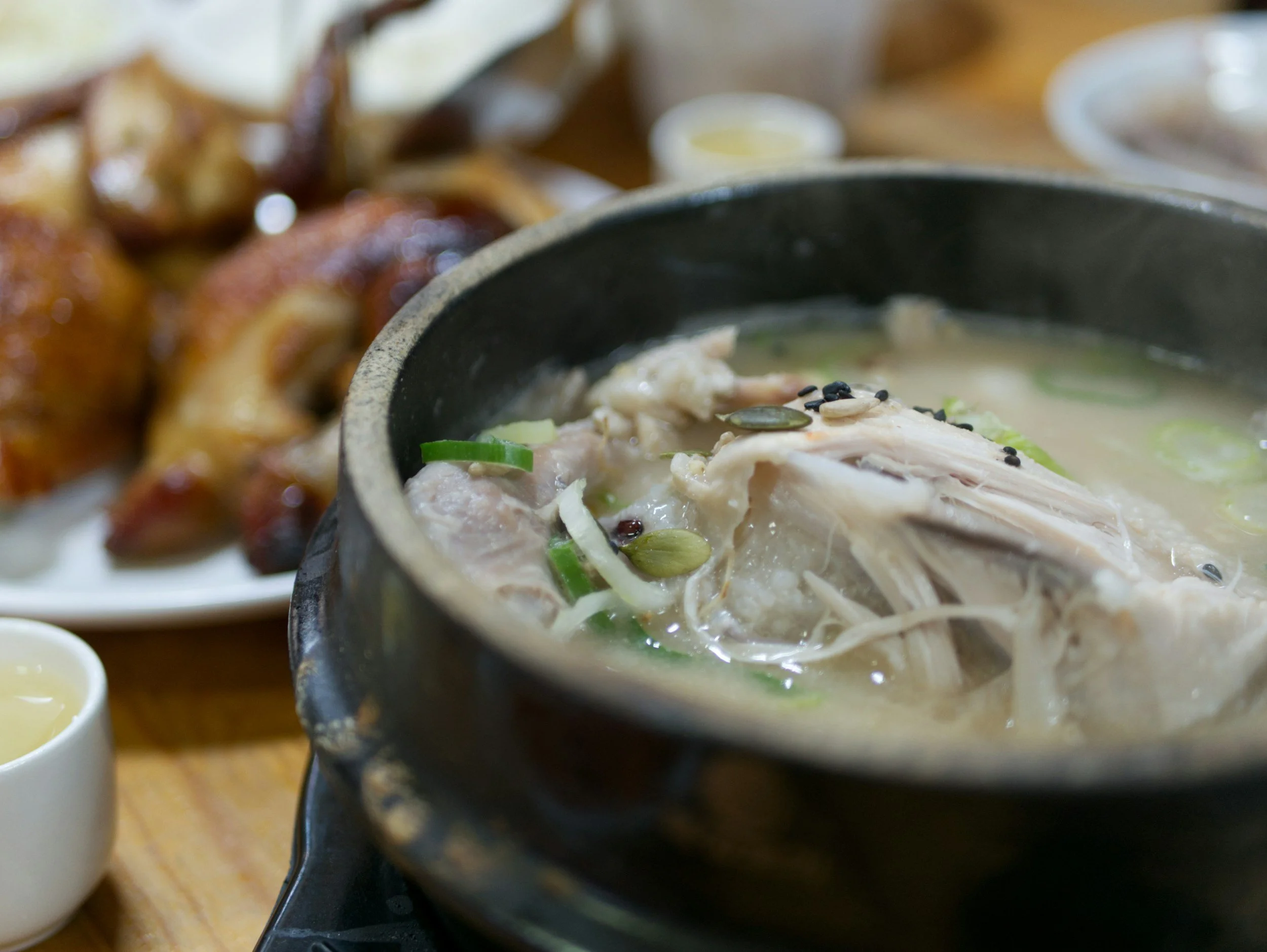
And what do Koreans traditionally eat on the hottest days of the year? A steaming, boiling-hot bowl of samgyetang (삼계탕) — a whole young chicken stuffed with glutinous rice, garlic, jujubes, and ginseng, simmered into a rich soup.
Hot soup in a heat wave sounds backwards until you understand the principle behind it: 이열치열 — "fight heat with heat." In Korean medical thinking, summer heat drives the body's yang energy outward to the surface, where you feel it as sweating and flushing. Meanwhile the core — the digestive center — is left relatively cold and depleted. It's why appetite sags in summer, why cold drinks all day can leave your stomach unsettled, and why people feel hollowed out by August. Samgyetang meets that problem directly: warming, easily digested, fortified with ginseng to restore the yang and qi that the season drains. You eat heat to rebuild the furnace, sweat freely, and walk out stronger than you came in.
This is one of the quiet pleasures of practicing Korean medicine in Koreatown: the tradition isn't theoretical here. Within a few blocks of my clinic on 6th Street, you'll find samgyetang houses with lines out the door on chobok, jungbok, and malbok — Angelenos of every background queuing in the heat for hot soup, participating in a seasonal medicine ritual that's centuries old. If your summer has left you feeling depleted rather than agitated — heavy limbs, weak appetite, drained rather than restless — a bok-day bowl of samgyetang is a genuinely appropriate remedy, and one of the most enjoyable prescriptions I can give. Malbok is August 14. You have time.
(One caution from the same tradition: if your pattern is the hot, agitated, can't-fall-asleep kind described above, deeply warming tonics like ginseng can add fuel to the fire. This is precisely why pattern diagnosis matters — the right summer remedy depends on whether you're depleted or overheated, and many people are some of both.)
When to Seek Treatment
Occasional rough nights during a heat wave are normal. Consider professional help when:
- Sleep trouble persists three or more nights a week for a month or longer.
- You're waking consistently in the early-morning hours and can't fall back asleep.
- You notice Heart-pattern signs alongside the insomnia — palpitations, chest heat, agitation, night sweats.
- Daytime fatigue, irritability, or brain fog are affecting your work, mood, or safety.
- You're relying on alcohol or sleep aids to fall asleep and want a different path.
- Summer reliably unravels your sleep every year — a pattern worth correcting, not just weathering.
Acupuncture pairs well with, and does not replace, medical care for conditions like sleep apnea, thyroid disorders, cardiovascular disease, or significant mental-health concerns. Part of a good first visit is sorting out what's actually driving your sleep loss. If something needs a physician or a sleep study, I'll tell you.
FAQ
Can acupuncture really help with insomnia, or is it just relaxation? The evidence goes beyond simple relaxation. Meta-analyses of randomized trials show acupuncture improves sleep quality more than sham needling, meaning the effect isn't only placebo. It appears to work by shifting the nervous system toward a calmer, rest-oriented state that supports both falling and staying asleep.
Why can't I sleep in summer even when I'm exhausted? Falling asleep requires your core body temperature to drop, and hot nights blunt that drop, leaving you tired but wired. Korean medicine adds a second layer: summer is the season of the Heart, and heat agitates the Heart and the mind it houses, so the mind won't settle. Both views point to the same fix — cool the body, calm the Heart.
What is sambok, and why do Koreans eat hot soup on the hottest days? Sambok (삼복) marks the three hottest points of the Korean summer — chobok, jungbok, and malbok. On these days Koreans traditionally eat samgyetang, ginseng chicken soup, following the principle of 이열치열, "fighting heat with heat." The idea is that summer heat pulls energy to the body's surface and leaves the digestive core depleted, so a warming, restorative soup rebuilds strength from the inside.
What should I eat if I'm overheated or heat-exhausted? Watermelon is the classic Korean medicine remedy for summer heat — intensely cooling, hydrating, and replenishing for a body drained by high temperatures. Cucumber, mung beans, and barley tea also help clear heat. True heat stroke, with confusion or loss of consciousness, is a medical emergency: call 911 first.
How many acupuncture sessions does it take to improve sleep? It varies by person and pattern, but many people notice changes within the first few sessions, and a typical course is weekly treatment for several weeks. Chronic insomnia usually needs a more sustained plan. Your practitioner should reassess progress and adjust as your sleep improves.
Is acupuncture safe if I'm already taking sleep medication? Yes — acupuncture is generally very safe and doesn't interact chemically with medications. Many patients use it while gradually reducing reliance on sleep aids, ideally in coordination with their prescribing doctor. Always tell your acupuncturist about all medications and conditions at your first visit.
This Summer, Take Care of Your Heart — and Your Sleep
Summer is Heart season. If the heat has left you wired at midnight and wrung out by morning, that's not something to push through — it's a pattern that can be treated. At Raah Acupuncture in Los Angeles Koreatown, I offer acupuncture for sleep grounded in classical Korean medicine and modern evidence, with an honest assessment of what will actually help you rest again.
Call 323-422-4964 or visit raahacupuncture.com to book your appointment. We're at 3407 W 6th St, Suite 702 — in the heart of Koreatown, a short walk from your next bowl of samgyetang.