
Six lines down the arm
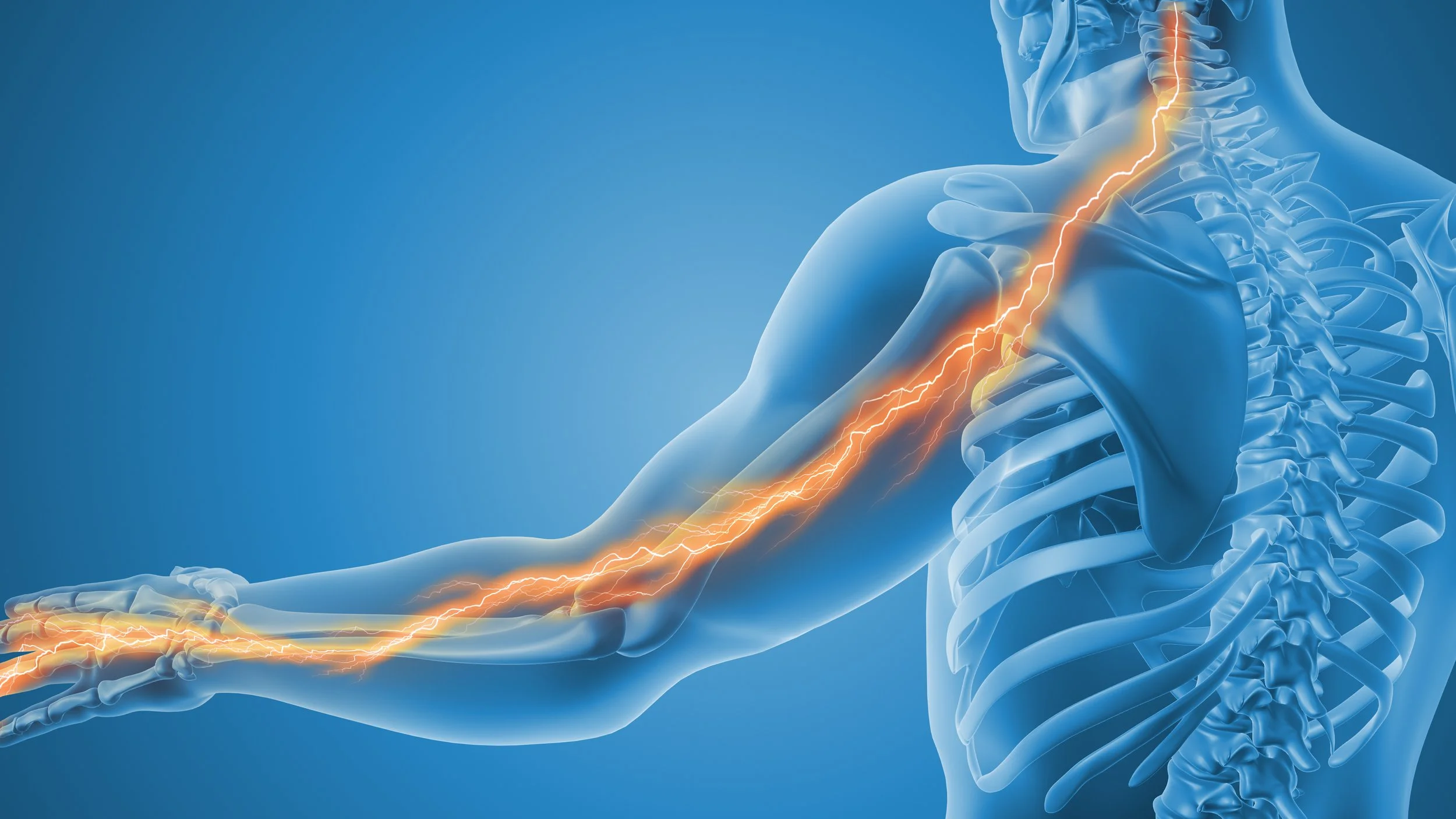
A shoulder that won't lift. An elbow that hurts every time you grip. A shoulder blade that burns by the end of the workday. They usually arrive with a name already attached — rotator cuff, frozen shoulder, tennis elbow, golfer's elbow. The name tells you which structure is involved. It doesn't tell you why one frozen shoulder answers to treatment that does nothing for the next.
The Donguibogam, the 1613 master text, gives the arm its own chapter — the most orthopaedic in the whole book. It measures every segment from shoulder to fingertip, maps where each kind of pain runs, and then sorts the arm that hurts and will not lift by cause. We translated it in full.
[→ The Hand — full translated chapter]
Show me where it runs
The first thing we'll ask is for you to trace the pain with a finger. The chapter explains why, in a passage that is still the most usable thing in it:
> Have the patient straighten both hands, let the arms hang against the body, thumbs forward and little fingers behind. Then: pain on the front edge belongs to one channel; on the back edge, to another; on the outer edge, to a third — and so on around the arm, six in all. Observe which channel it is, and treat with needles and medicine accordingly.
Six lines, each with its own points. Pain at the front of the shoulder, pain at the back running into the shoulder blade, pain along the outside of the elbow, pain on the inner elbow — these look like one problem in the arm and are six different ones in the treatment room. The chapter adds a detail worth knowing: the inner elbow is where the Lung and Heart channels pass, so a stubborn inner-elbow complaint is a reason to ask about the chest, not only the elbow.
Bends, or straightens?
The second test is two lines long and still holds:
> When the hand bends but will not straighten, the disease is in the sinews; when it straightens but will not bend, the disease is in the bone. What is in the bone, treat at the bone; what is in the sinew, treat at the sinew.
In modern terms: lost extension usually points to tight soft tissue; lost flexion points to the joint itself. It decides how deep we work and where.
The questions that sort it
**Did it start overnight?** The chapter names two scenes precisely: the arm left outside the covers on a cold night, and the nursing mother who sleeps with her baby pillowed on her arm. Both describe a limb held still in one position while it cools — a very recognizable account of how a shoulder becomes painful by morning. Read as cold, wind, or damp, depending on how it behaves.
**Is it stiff and aching, worse in damp weather?** — wind and damp lodged in the channels. The most common pattern, and the one most people expect.
**Does it move — one arm, then the other — and hurt more than anything on examination explains?** — the chapter's most surprising teaching. Pain that shifts from side to side, that won't let you get comfortable sitting or lying, that seems out of proportion to the findings: the text says people take it for a wind pattern, and it isn't. It reads this as phlegm-rheum originating in the stomach region, rising into the arm. The treatment is aimed there, not at the shoulder. Numbness and trembling in the arm are grouped in the same family.
**Does it get worse with stress?** — arm pain from the emotions has its own formula in the chapter.
**Does it run down into the shoulder blade?** — the arm-and-scapula pattern, with its own formula and its own two-point needling prescription.
**Did it follow an injury?** — post-traumatic pain of the hands and feet is named separately.
The shoulder blades and the working back
Pain between and under the shoulder blades belongs to the next part of the body, and the Donguibogam's Back chapter has a line about it that patients usually recognize at once: back pain of this kind comes from labour, and it is common in people who work at a craft and in those who work long and hard at a desk. It gives one point for it above all others, between the shoulder blades, and recommends moxibustion there.
The same chapter records a case worth reading: a man with a line of pain running from between his shoulder blades over the shoulder and down to the side of his chest, day and night. The physician traced it to worry over a plan that had failed. Treatment aimed at that, and it resolved.
[→ The Back — full translated chapter]
What treatment looks like here
Acupuncture is the main tool, and the points follow the line the pain runs on. The chapter's prescription for a shoulder that cannot move and an arm that cannot be raised is still the classic one for frozen shoulder — LI15 Jianyu and LI16 Jugu at the shoulder, TE11 Qinglengyuan on the upper arm, and TE1 Guanchong at the tip of the ring finger. Local, adjacent, and distal in one prescription: the pattern for a joint that has lost range rather than merely hurting.
For the elbow it names TE10 Tianjing and LU5 Chize; for pain in both shoulder blades, GB21 Jianjing with TE6 Zhigou on the forearm. The wrist has its own page — [Wrist pain].
Herbal formulas follow the cause. From the chapter:
[Hwallak-tang 活絡湯] — wind and damp, the stiff aching arm
[Ojeok-san 五積散] — the arm that went cold overnight
[Ganghwang-san 薑黃散] — Qi and Blood stagnating in the arm
[Baekgaeja-san 白芥子散] — arm pain that follows the emotions
[Oryeongji-san 五靈脂散] — pain of the arm and shoulder blade
[Sodambokryeong-hwan 消痰茯苓丸] — the shifting, phlegm-rheum arm
[Eungtong-won 應痛元] — pain after an injury
A fresh strain often eases within a few sessions. Frozen shoulder and long-standing tendon problems take longer — weeks to months — and range of motion usually returns before the last of the pain does.
Read a documented case — [Shoulder pain limiting swimming]
If your shoulder pain comes with a stiff neck, read more here — [Neck pain]
## Please read this part
Some arm and shoulder pain needs a physician first, and not later.
**Get urgent evaluation if you have:** sudden weakness or numbness in one arm, especially with facial drooping or trouble speaking; pain in the left shoulder, arm, or jaw with chest pressure, shortness of breath, or sweating; inability to lift the arm after a fall; or a hot, red, swollen joint with fever. These can indicate stroke, heart attack, dislocation or fracture, or joint infection.
**Get evaluated before starting here if you have:** numbness or weakness running down the arm into the hand, shoulder pain that wakes you at night with weight loss, a history of cancer, or arm pain after an accident that hasn't been examined.
The 1613 chapter has its own version of this warning. It says cold aching at the top of both shoulders must not be neglected — it had been seen again and again in people about to suffer a stroke — and that moxibustion should begin as soon as it is felt. And it notes that disease of the Lung and Heart shows itself at the elbows. The specifics belong to their era; the instinct to look past the arm is right.
**This approach may help if you're dealing with:** frozen shoulder · rotator cuff strain or impingement · a shoulder that hurts when you reach overhead · pain between or under the shoulder blades · tennis elbow or golfer's elbow · an