
Wrist Pain
Where three lines meet
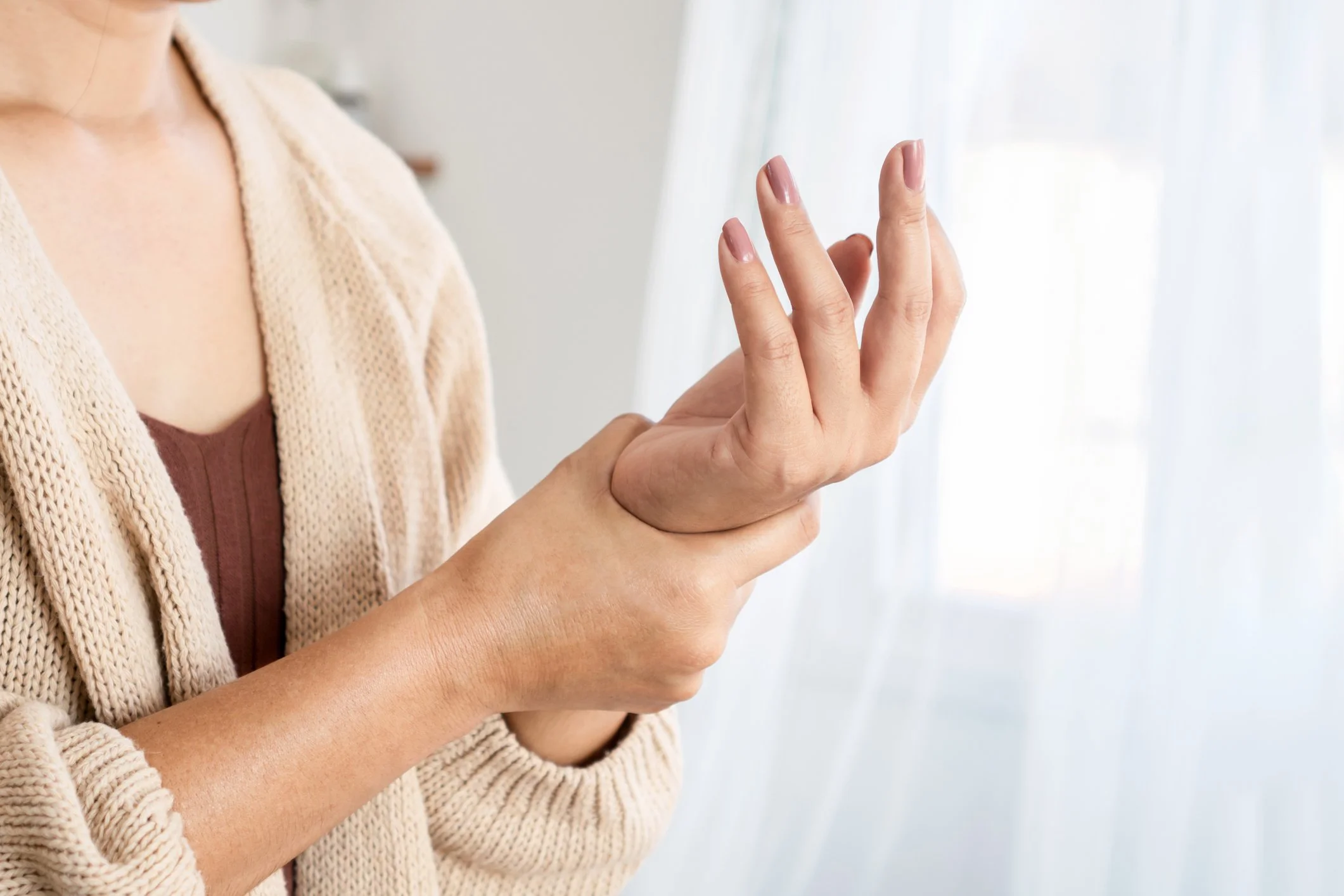
Wrist pain rarely arrives alone. It comes from typing, from a mouse, from a phone held for hours, from lifting a baby dozens of times a day, from a job that repeats the same motion until the joint protests. It usually has a name — carpal tunnel, tendinitis, a sprain — and the name is often right. What it doesn't explain is why the ache climbs into the forearm, or why one wrist settles with rest and another keeps coming back.
Korean medicine reads the wrist as a meeting point rather than a joint on its own. The Donguibogam, the 1613 master text, describes three of the arm's sinew channels rising from the fingertips and binding at the wrist before running on to the elbow, the shoulder, and the neck. Their disease, it says, is pulling and cramping wherever they pass. A strained wrist is the place the problem shows; the line it sits on is where the treatment goes.
[→ The Sinews — full translated chapter]
Which side of the wrist?
The first thing we'll ask is for you to point to it. The Donguibogam's Hand chapter teaches the arm as six lines, and the wrist is where they are easiest to tell apart:
**The thumb side.** Pain where the thumb meets the wrist, worse gripping, pinching, or lifting with the thumb out — common in new parents and in anyone who texts or uses a mouse for long hours. This lies on the line that runs up the front edge of the arm to the shoulder.
**The little-finger side.** Pain on the outer edge of the wrist, worse turning the forearm or bearing weight on the hand — push-ups, getting up from a chair. This line runs up the back of the arm and wraps around the shoulder blade.
**The back of the wrist, in the middle.** Aching across the top of the wrist, worse bending it back — common with keyboards set too high. This line runs up the outside of the arm to the side of the neck.
**The palm side, with numbness in the fingers.** Tingling in the thumb, index, and middle fingers, often worse at night or on waking, sometimes with clumsiness — the classic carpal tunnel picture. The palm side of the wrist carries the three inner lines of the arm, and this presentation sits on the middle one.
Each line has its own points, which is why two people with "wrist pain" can leave with very different treatments.
[→ The Hand — full translated chapter]
Bends, or straightens?
The Hand chapter gives a two-line test that applies to the wrist and fingers as well as anywhere:
> When the hand bends but will not straighten, the disease is in the sinews; when it straightens but will not bend, the disease is in the bone.
Lost extension usually means tight, irritated soft tissue — the tendon picture. Lost flexion points toward the joint itself. It tells us how deep to work, and whether imaging is worth asking about.
When the fingers go numb
Numbness is handled differently from pain. The Donguibogam classes finger numbness as a problem at the level of the skin, and in the Hand chapter it groups arm pain, numbness, and trembling together as signs of phlegm-rheum — an obstruction that begins in the digestive centre and rises into the limbs.
The modern reading is different in vocabulary but similar in instinct: numbness in the hand is not always a wrist problem. It can come from the neck, from blood sugar, from thyroid function, or from fluid retention in pregnancy. That is why we ask about more than the wrist — and why numbness that is steadily worsening should be checked by a physician first.
If your hand symptoms come with a stiff neck, read more here — [Neck pain]
What treatment looks like here
Acupuncture is the main tool. The Hand chapter names the wrist points directly: for wrist pain, LI5 Yangxi at the thumb side of the wrist, LI11 Quchi at the elbow, and SI4 Wangu on the little-finger side. For pain running through the elbow, forearm, and wrist together, it uses three points on the hand itself — SI2 Qiangu, TE2 Yemen, and TE3 Zhongzhu. Working at the elbow and the hand for a wrist problem is the sinew-channel idea in practice: treat the line, not only the spot.
Herbal medicine plays a smaller part for most wrist pain. Where the wrist is one piece of a wider pattern — wind and damp in the joints, poor circulation in the arm, numbness with a phlegm picture — the formulas from the [Shoulder & Arm Pain] page apply.
What you do between visits matters more for the wrist than for most joints:
- Breaks from
repetitive work every 30–45 minutes, even for a minute
- A keyboard and mouse at elbow height, wrists straight rather than bent back
- For night numbness, a simple splint that keeps the wrist straight while you sleep
- For new parents, lifting the baby with the palms up and the forearms doing the work, rather than the thumbs
A recent strain or tendon flare often settles within a few sessions. Long-standing carpal tunnel symptoms and chronic tendinitis take longer, and progress depends on how much the aggravating activity can be changed.
## Please read this part
Some wrist pain needs a physician first, and not later.
**Get urgent evaluation if you have:** wrist pain after a fall onto an outstretched hand, especially with tenderness in the hollow at the base of the thumb — a scaphoid fracture can look normal on the first X-ray and heal poorly if missed; a hot, red, swollen joint with fever; or sudden weakness or numbness in one hand together with facial drooping or trouble speaking.
**Get evaluated before starting here if you have:** numbness that is constant rather than coming and going, weakness or dropping things, visible thinning of the muscle at the base of the thumb, numbness in both hands, or wrist pain after a work or car accident that hasn't been examined. These can mean nerve compression that needs testing, or a cause higher up in the neck.
**This approach may help if you're dealing with:** carpal tunnel symptoms, once evaluated · thumb-side wrist pain from texting, mousing, or lifting a baby · wrist tendinitis from repetitive work · pain on the little-finger side when bearing weight · a wrist that aches up into the forearm and elbow · a lingering sprain · wrist and hand pain from a workplace injury.
The Donguibogam translation project at formulas.raahacupuncture.com is researched and translated by Eui Young (Justin) Chung, L.Ac., Dipl. O.M. — the same clinician you'll see in the treatment room.