
Outside, or inside?
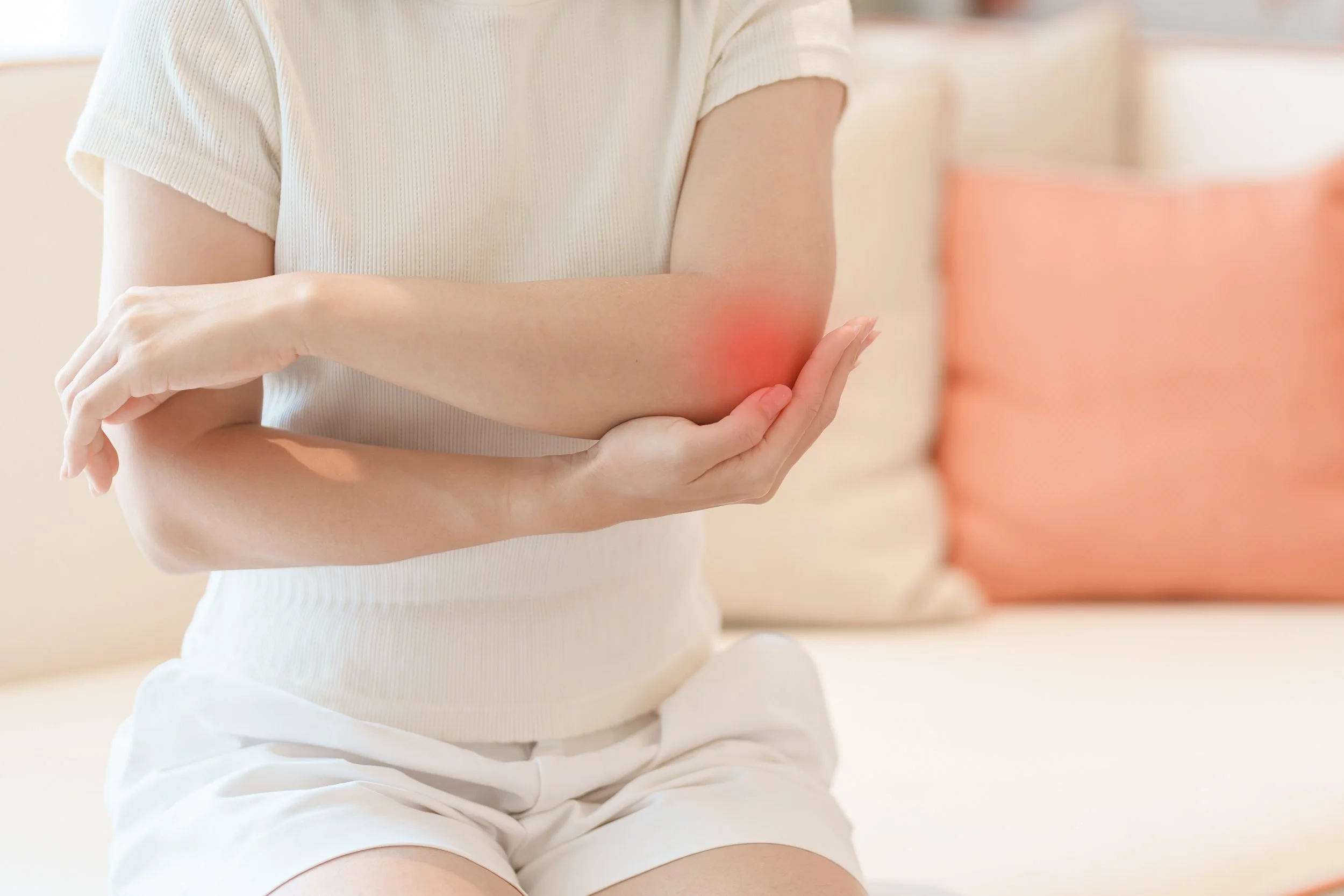
Tennis elbow is rarely about tennis. It comes from gripping — a mouse held all day, a hammer or a wrench, a heavy bag carried by the handle, a pan lifted with one hand, a toddler hoisted again and again. Golfer's elbow is its mirror image on the inner side, and it has even less to do with golf. Both are usually called tendinitis, and the name is fair. What it doesn't explain is why one elbow settles in a few weeks and another lingers for a year.
The Donguibogam, the 1613 master text, never uses either name. But its Hand chapter divides the arm into six lines, names the points for the elbow on each, and draws a clear distinction between the outside of the elbow and the inside — one that still decides how we treat it. We translated it in full.
[→ The Hand — full translated chapter]
The outer elbow
Pain on the outside of the elbow, worse gripping or lifting with the palm facing down, often running down the back of the forearm toward the wrist — this is tennis elbow.
In the chapter's map of the arm, this is the line that runs from the index finger up the front-outer edge of the arm to the front of the shoulder. The points it names along that line at the elbow are still the ones used every day for this complaint: LI11 Quchi at the crease, LI10 Shousanli just below it, and LI12 Zhouliao just above — which sits almost exactly where a tennis elbow is most tender. The same line explains a pattern patients often notice: an outer elbow that has been sore for months tends to bring the front of the shoulder along with it.
The inner elbow
Pain on the inside of the elbow, worse with gripping, wrist bending, or lifting with the palm facing up — this is golfer's elbow.
Here the chapter adds something unexpected. Quoting the Divine Pivot, it says:
> When there is evil in the Lung and Heart, its Qi flows into the two elbows.
The Lung and Heart channels both pass through the inner elbow, and the text treats a persistent inner-elbow complaint as a reason to ask about the chest, not only the arm. For an inner elbow that cramps and won't relax, it names LU5 Chize, at the elbow crease on that side.
Three lines bind at the elbow
The Donguibogam's Sinews chapter describes three of the arm's sinew channels rising from the fingertips, binding at the wrist, then binding again at the elbow on their way to the shoulder and neck. Their disease, it says, is pulling and cramping wherever they pass.
That is the reason we rarely treat an elbow at the elbow alone. A sore outer elbow usually has a tight forearm below it and a guarded shoulder above it, and the sinew channel is the line that connects them.
[→ The Sinews — full translated chapter]
Bends, or straightens?
The Hand chapter gives a short test that applies here directly:
> When the hand bends but will not straighten, the disease is in the sinews; when it straightens but will not bend, the disease is in the bone.
For an elbow that cannot fully bend or straighten, the chapter names a pair of points — TE10 Tianjing just above the back of the elbow, and LU5 Chize at the front. An elbow that has lost range is a different problem from one that only hurts, and it is one of the signs that tells us whether imaging is worth asking about.
The questions that sort it
**Outside or inside?** — the first and most important question, because it decides which line we work on.
**Did it start with something new?** — a new job, a new tool, a renovation, a new baby, a new sport. A clear trigger usually means a clear path out.
**Does it run down toward the wrist, or up toward the shoulder?** — tells us how much of the line is involved. If it is mainly the wrist, read more here — [Wrist pain]. If it is mainly the shoulder — [Shoulder & arm pain].
**Is it worse in the cold, or stiff first thing in the morning?** — points toward cold and damp settling in the channel, and changes how we use heat and moxibustion.
**Has it been months?** — long-standing elbow pain behaves differently from a fresh flare. It needs more sessions, and it needs the loading at work or at home to change.
## What treatment looks like here
Acupuncture is the main tool: points along the affected line at the elbow, in the forearm, and at the hand. For pain running through the elbow, forearm, and wrist together, the chapter uses three points on the hand itself — SI2 Qiangu, TE2 Yemen, and TE3 Zhongzhu — which is why a sore elbow can loosen from points nowhere near it. Moxibustion and infrared heat are used where cold or stiffness dominates.
Herbal medicine plays a smaller part for most elbow pain. Where the elbow is one piece of a wider pattern in the arm, the formulas on the [Shoulder & arm pain] page apply.
What you do between visits matters as much as the treatment:
- Lift with the palm facing up where you can, and with both hands rather than one
- Loosen your grip — on the mouse, the steering wheel, the tool handle; a thicker handle helps
- A forearm strap just below the elbow can take load off the tendon during work
- Don't stop using the arm entirely. Gentle, gradual loading helps a tendon recover; complete rest usually doesn't
A recent flare often settles within a few weeks. Elbow pain that has been present for months usually takes longer — several weeks to a few months — and improves fastest when the gripping that caused it can change.
## Please read this part
Some elbow pain needs a physician first, and not later.
**Get urgent evaluation if you have:** elbow pain after a fall with swelling, deformity, or inability to straighten the arm; a sudden pop at the front of the elbow followed by bruising and weakness bending the arm, which can be a torn biceps tendon and is time-sensitive to repair; a hot, red, swollen elbow with fever; or pain in the inner arm together with chest pressure, shortness of breath, or sweating.
**Get evaluated before starting here if you have:** numbness or tingling in the ring and little fingers, weakness in the hand, elbow pain that wakes you at night with weight loss, or elbow pain after a work or car accident that hasn't been examined.
The 1613 text draws a version of the same line. Its note that disease of the Lung and Heart shows itself at the elbows is a reminder that not every elbow problem starts in the elbow.
**This approach may help if you're dealing with:** tennis elbow · golfer's elbow · elbow pain from gripping tools or a mouse · forearm pain that runs to the wrist · elbow pain after a renovation, a new job, or a new baby · an elbow that has been sore for months · elbow and forearm pain from a workplace injury.
The Donguibogam translation project at formulas.raahacupuncture.com is researched and translated by Eui Young (Justin) Chung, L.Ac., Dipl. O.M. — the same clinician you'll see in the treatment room.