
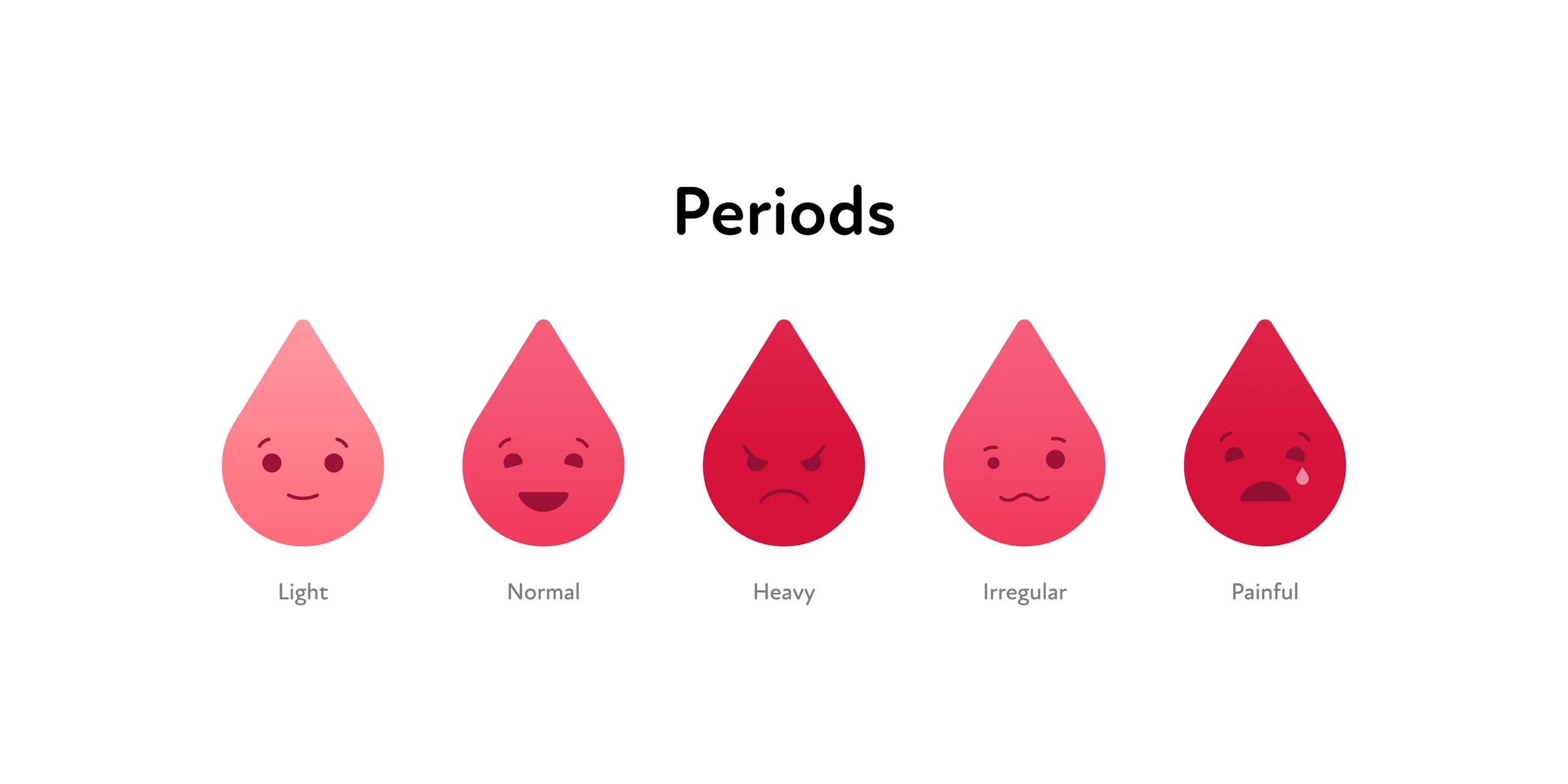
Almost everyone who menstruates has, at some point, looked down and wondered what the color meant. Bright red one cycle, nearly brown the next. Clots one month, none the next. Cramping that starts the day before, or cramping that only shows up after the flow has begun.
Most modern medical advice answers this briefly: color mostly reflects how quickly blood leaves the body, and small clots are usually normal. That's true, and it's reassuring as far as it goes. But it also leaves a lot of people with a question nobody is answering — my period changed, and I want to know what changed.
Korean medicine has been answering that question, in considerable detail, for four hundred years.
The chapter that reads the cycle like a lab panel
The Donguibogam (동의보감 東醫寶鑑), completed in 1613, is the master text of Korean medicine. One of its chapters is devoted entirely to the womb and the menstrual cycle. Its premise is simple and, for many patients, validating: a cycle that is off is not a personality trait. It's a finding. The text puts it plainly — the menses are supposed to appear at their term, so a cycle that misses its term is, by definition, something to look into.
What makes the chapter unusual is how systematically it reads the flow itself. It gives what amounts to a chart: color by color, consistency by consistency, with a different treatment attached to each.
Our clinic translated this chapter into English in full — original text, translation, and clinical commentary. You can read it here: The Womb — full translated chapter.
The two questions the text asks
Underneath the whole chart are two organizing ideas, and they're worth knowing even if you never take an herb:
Color reports on temperature. Consistency reports on movement.
That is: how red or dark the blood is tells you something about heat; whether it clots or flows tells you something about circulation. Two different axes, two different problems, two different treatments.
And then the timing question, which is the single most useful thing in the chapter:
Pain before the flow means something to move. Pain after the flow means something to feed.
In the text's own framing, cramping that arrives before bleeding starts is a sign of repletion — something stalled that needs to get moving. Cramping that shows up after the flow, when things are winding down, is vacuity — the body has spent more than it had. These call for opposite approaches, and this is one of the more common places where treatment goes wrong.
The color chart, in modern terms
Here's how the chapter sorts it. I've kept the classical categories and added what they tend to correspond to clinically.
Bright red, flowing freely, minimal clotting — the text calls this the correct color, and says something clinically generous about it: even if the timing is off, a cycle whose color is right is easy to regulate. In practice this is the most reassuring finding on the list.
Purple — read as heat with an element of wind. Often seen with cycles that also run early.
Black or very dark — read as heat at its most intense. This is worth pausing on, because it runs directly against the assumption most people make (more on that below).
Clotted, with the color unchanged — read as stagnation of Qi: not a heat problem, a movement problem. Clinically this is the pattern that most often comes with cramping that peaks right before or at the start of the flow.
Pale, thin, washed out — read as depletion. Often accompanies fatigue, dizziness on standing, and cycles that run late.
Thin and watery, or brownish and murky — read as dampness diluting the blood. Often in people who also report heaviness, bloating, or sluggish digestion.
The warning that surprises people
Here's the part that makes this chapter worth reading rather than just summarizing.
There's a widespread assumption — in wellness culture, in a lot of casual advice, and honestly among some practitioners — that dark blood, clots, and cramping all mean cold, and that the answer is warmth: heating pads, warming herbs, hot foods, ginger.
The 1613 text explicitly warns against this. Its position is that people see dark or purple blood, or clots, or pain, and reflexively call it wind-cold and reach for hot medicines — and that the harm from doing so arrives faster than you can turn around. In the chapter's reading, purple is heat, and black is heat at its worst.
That doesn't mean warmth is never right. Cold patterns absolutely exist in this system, and the same chapter has warming formulas for them. What it means is that darkness alone doesn't tell you which one you're looking at — you need the rest of the picture: when the pain falls, whether the flow is heavy or scant, whether the person runs hot or cold, what the tongue and pulse show.
This is the practical reason a consultation asks so many questions that seem unrelated to the period.
What about clots specifically?
Small clots — dime-sized or smaller, occasional, on your heaviest day — are common and generally not concerning from a conventional medical standpoint.
The classical reading adds a layer: clots with unchanged color point to stagnation, and stagnation is usually accompanied by cramping that arrives before the flow. That combination — pre-flow cramping plus clots — is one of the more recognizable patterns in the chapter, and it's the one classical formulas address most directly. The chapter's dedicated formula for exactly this presentation is Cheongyeoljohyeol-tang 淸熱調血湯, which combines blood-moving herbs with cooling ones — again, on the reasoning that the stalling itself generates heat.
Clots that are consistently larger than a quarter, or a flow that soaks through a pad or tampon every hour for several hours, is a different situation and should be evaluated by a physician. That is not a classical-versus-modern disagreement; heavy bleeding needs a workup for anemia and for structural causes like fibroids or polyps.
Where emotions enter — and why that isn't hand-waving
One more thing this chapter does that modern texts generally don't: it names emotional and social circumstances as direct causes of menstrual problems, and prescribes for them specifically.
Periods that stop under sustained strain are given their own explanation and their own formula — and notably, not a formula that forces the cycle open. The reasoning is that if the cycle stopped because the person is under pressure, forcing it is treating the wrong thing.
And in the section on heavy bleeding, one of the three named causes is a reversal of fortune — the loss of status or financial security. The text warns that such a patient may look perfectly well and that the examination may show little. Its first instruction to the physician isn't an herb at all: talk with her first, until things settle, and then prescribe.
Whatever you make of the underlying theory, that is a seventeenth-century text prescribing a conversation as the opening move of treatment for a physical symptom. It's also the classical root of what Korean medicine later named hwa-byeong (화병) — illness arising from suppressed anger and grief, which is recognized specifically as a Korean cultural syndrome.
What we do with this in the clinic
Practically, a menstrual consultation here asks about five things — the same five the chapter opens with:
Timing — early, late, or unpredictable
Volume — heavy, scant, or changed from your baseline
Pain, and when — before, during, or after the flow
Color — bright, dark, pale, brown
Consistency — clots, thin, thick
Those five answers, plus tongue and pulse, sort most cases into a recognizable pattern, and the treatment follows from the pattern rather than from the diagnosis label. Two people with the same diagnosis of dysmenorrhea can need opposite formulas — which is why there has never been a single "period formula" in this tradition, and why we don't offer one.
Read more about how we approach this: Menstrual Health
---
Frequently asked questions
Does dark or brown period blood mean something is wrong?
Usually not by itself. Brown blood at the very beginning or end of a period is typically older blood that left the body slowly. In the classical framework, persistently dark blood across the whole flow is read as heat rather than cold — which matters mainly because it argues against the common instinct to treat everything dark with warming remedies.
Do period clots mean I have endometriosis or fibroids?
Not necessarily. Small occasional clots are common. However, consistently large clots, very heavy flow, or pain that is worsening over time should be evaluated by a gynecologist — endometriosis and fibroids are diagnosed with examination and imaging, not with color.
Is cramping before my period different from cramping after?
In this tradition, yes, and importantly so. Pain before the flow is read as something stalled that needs moving; pain after is read as depletion needing to be replenished. The treatments are close to opposite, which is why we ask about the timing rather than just the severity.
Can acupuncture help period pain?
Menstrual pain is one of the more commonly treated complaints in acupuncture practice, and one where patients often notice change within two to three cycles. Treatment is typically timed to the cycle — often beginning in the week before the period — and combined with herbal formulas chosen by pattern.
Do I need herbs, or is acupuncture enough?
Both are used. Acupuncture tends to address pain and the stress-cycle connection; herbal formulas do the slower work of changing the flow's quality over several cycles. Which you need depends on your pattern and your goals, and we'll discuss it at the consultation.
When should I see a doctor instead?
Bleeding heavy enough to soak a pad or tampon hourly, bleeding between periods, bleeding after menopause, sudden severe pelvic pain, or a new pelvic mass all warrant prompt medical evaluation. We work alongside gynecological care, not in place of it, and we'll tell you when something belongs there first.
---
Eui Young (Justin) Chung, L.Ac., Dipl. O.M. practices at Raah Acupuncture in Koreatown, Los Angeles. He is the translator of the ongoing English edition of the Donguibogam's clinical chapters at formulas.raahacupuncture.com.